If you’ve been researching LED strip lights, you’ve noticed most products are labeled as 12V or 24V. These are low voltage LED strips, and they dominate the residential, commercial, and DIY lighting markets for good reason.
Unlike high voltage (110V/220V) alternatives, low voltage strips are safer, more flexible, and far easier to install. But what exactly makes them so popular? And how do you choose between 12V and 24V for your specific project?
This guide explains everything you need to know about low voltage LED strips—from basic safety benefits to voltage drop management and smart control integration.
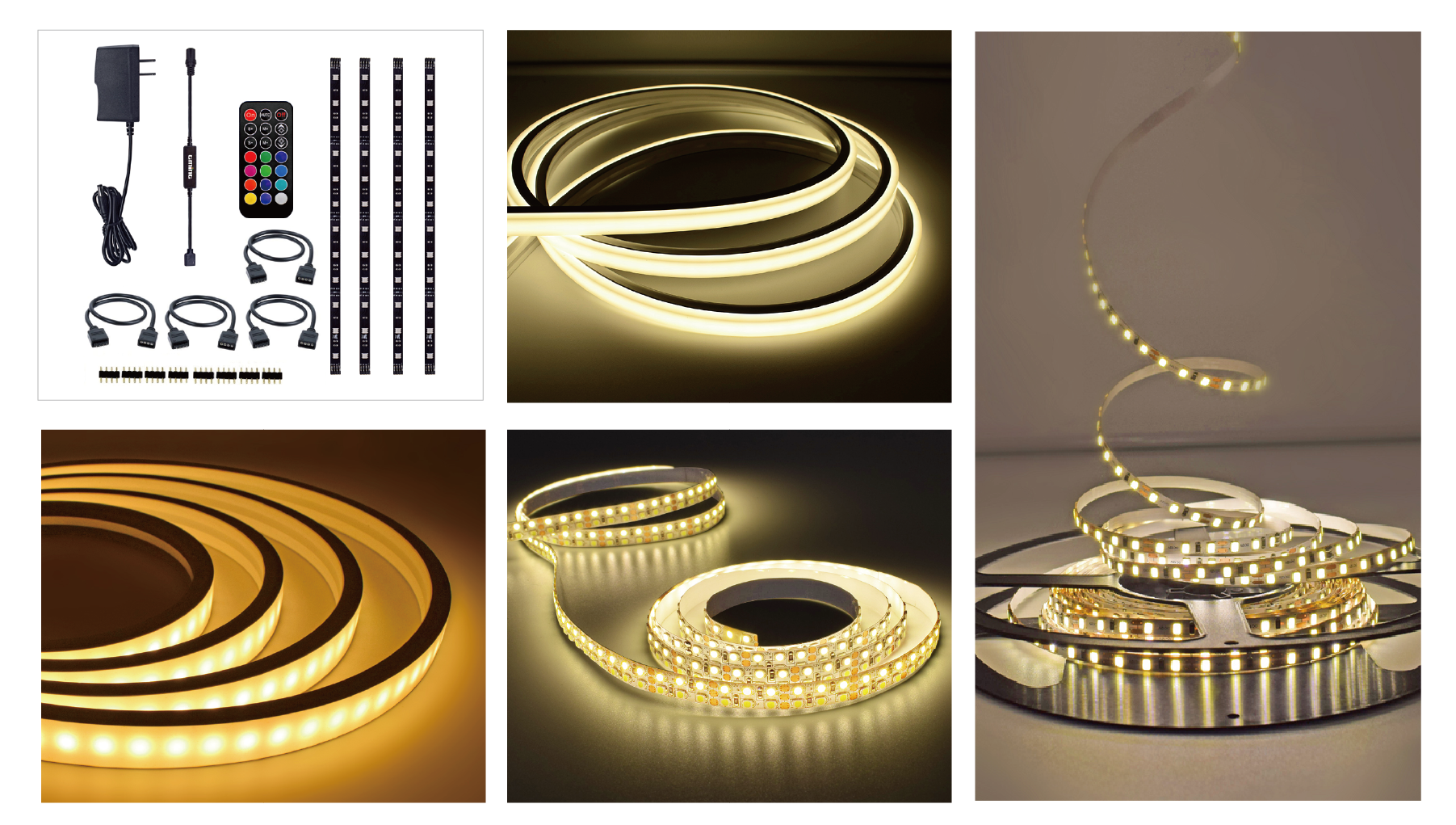
A low voltage LED strip operates on either 12 volts DC or 24 volts DC. These strips require a driver (also called a power supply or transformer) to convert standard household AC electricity (110V–240V) into the low DC voltage the strip needs.
Low voltage strips are the industry standard for under-cabinet lighting, cove lighting, TV backlighting, display cases, and outdoor accent lighting. They are available in a vast range of types: single color, tunable white, RGB, RGBW, addressable, and COB flexible LED strip lights (dotless).
Low voltage (12V/24V) is considered safe to touch even when powered. This makes low voltage strips ideal for:
In contrast, high voltage strips carry the same electricity as wall outlets—a serious shock hazard.
Low voltage strips are designed to be cut at regular intervals (usually every few inches). This allows you to achieve exact custom lengths for any space. Many high voltage strips have much longer minimum cut lengths (50cm or more), making them impractical for small or intricate installations.
Because low voltage systems are exempt from many electrical codes that apply to line voltage wiring, you can typically install them without permits or licensed electricians (check local regulations). This saves time and money on professional labor.
Most low voltage LED strips are dimmable when paired with a compatible dimmable driver and controller. You can integrate them with smart home systems (Alexa, Google Home, HomeKit) using WiFi, Zigbee, or Bluetooth controllers.
| Factor | 12V System | 24V System |
|---|---|---|
| Maximum run before voltage drop | Approximately 5 meters (16 feet) | Approximately 10–15 meters (32–50 feet) |
| Power supply size | May need multiple supplies for long runs | Fewer supplies needed |
| Wire thickness required | Thicker wire for same wattage | Thinner wire possible (half the current) |
| Availability | Extremely common, huge variety | Common, growing quickly |
| Best for | Small projects, single cabinets, accent pieces | Large rooms, long perimeters, commercial displays |
Our recommendation: For new projects, choose 24V whenever possible. It handles longer runs without voltage drop, uses thinner wire, and generally performs better. Use 12V only for very small runs (under 5 meters) or when a specific product (like some addressable strips) is only available in 12V.
Voltage drop is the gradual loss of voltage as electricity travels along a long strip. It causes the far end of a run to appear dimmer than the near end—sometimes with a noticeable color shift (white turning yellowish).
Symptoms: A 5-meter 12V strip may be bright at the start but visibly dim in the last meter.
Solutions:
Choose 24V – Doubles your maximum run length without drop.
Inject power at both ends – Feed power to the far end as well as the near end.
Use multiple power supplies – For very long runs (over 15 meters), break the run into segments, each with its own supply.
For most home installations, 24V strips eliminate voltage drop issues entirely without extra work.
Not all low voltage strips dim equally. A true dimmable LED strip should:
Dim smoothly from 100% down to 1% without flicker
Produce no audible buzzing (coil whine) from the driver
Be compatible with standard TRIAC wall dimmers (when paired with a dimmable driver) or PWM controllers
If dimming is important for your project—such as in a bedroom, home theater, or restaurant—explicitly look for “dimmable” in the product specs and pair the strip with a compatible dimmable power supply.
CRI measures how accurately a light source reveals true colors. For kitchens, bathrooms, retail displays, and art galleries, choose strips with CRI 90+. Standard strips often have CRI 80, which can make colors look dull. Many COB strips naturally offer CRI 90+ due to their phosphor coating.
IP20: Indoor dry locations only.
IP65: Splash-proof – suitable for kitchens, bathrooms, covered outdoor areas.
IP67/IP68: Submersible – for ponds, fountains, or fully exposed outdoor use.
Select the IP rating based on your installation environment. You don‘t need IP67 for under-cabinet kitchen lighting, but you definitely shouldn’t use IP20 on a damp patio.
The 2835 SMD LED is one of the most popular and reliable LED chip packages for low voltage strips. The numbers refer to the chip dimensions: 2.8mm x 3.5mm.
Why 2835 is so popular:
Excellent efficiency – high lumens per watt
Good heat dissipation – runs cooler than older 3528 or 5050 designs
Wide beam angle (120° typical)
Available in single color, tunable white, and even some RGB configurations
When you see a high-quality white or single-color strip, it‘s very likely using 2835 LEDs. For applications where you need reliability and brightness without breaking the bank, 2835 is an excellent choice.
Under-cabinet kitchen lighting – Provides task illumination without shadows.
Cove lighting – Adds ambient glow to living rooms and bedrooms.
Staircase lighting – Improves safety with gentle, low-glare light.
Closet and wardrobe – Lights up dark interiors without heat buildup.
Retail display shelves – Highlights products with even, attractive light.
Restaurant and bar accents – Creates mood and highlights architectural features.
Office perimeter lighting – Reduces eye strain with indirect illumination.
Deck and patio perimeters – Defines outdoor living spaces at night.
Pathway guides – Low-level lighting for safety and aesthetics.
Under-awning illumination – Adds ambiance without harsh glare.
Step 1: Determine your voltage – 24V for runs over 5 meters or future flexibility; 12V for small, short runs.
Step 2: Choose your light type – Single color (fixed white or color), tunable white (adjustable color temperature), RGB (color changing), RGBW (color + dedicated white), or addressable (animated effects).
Step 3: Select brightness and density – Standard 60 LEDs/m is sufficient for most accent lighting. For task lighting or higher brightness, choose 120 LEDs/m or a high-lumen 2835 strip.
Step 4: Consider CRI and color temperature – For white light, 2700K–3000K (warm) for relaxing areas, 4000K–4500K (neutral) for kitchens and offices, 5000K+ (cool) for task-focused spaces. Always aim for CRI 90+ if color accuracy matters.
Step 5: Verify dimming requirements – If you need adjustable brightness, ensure the strip and driver are both rated as dimmable LED strip compatible.
Step 6: Check IP rating – Match to your installation environment.
Mistake #1: Using 12V for a run longer than 5 meters – Expect visible voltage drop. Upgrade to 24V or plan for power injection.
Mistake #2: Ignoring the driver‘s capacity – Always add a 20% buffer to your power supply wattage. A 100W strip needs at least a 120W driver.
Mistake #3: Buying a non-dimmable strip for a dimmable project – Not all strips are dimmable. Check specs carefully.
Mistake #4: Overlooking CRI – Low CRI (80 or below) makes colors look washed out. For kitchens and retail, CRI 90+ is worth the small premium.
Mistake #5: Skipping the aluminum channel – Even a high-quality low voltage strip will show individual LEDs if installed without a diffuser channel. For a professional finish, always use a channel with a frosted cover.
Low voltage LED strips (12V and 24V) are the right choice for virtually all residential and most commercial lighting projects. They are safe, flexible, and available in countless configurations to match any design vision.
At GminG LED, we specialize in low voltage LED strip lighting. Our extensive catalog includes low voltage LED strip options in all popular types, from high-efficiency 2835 SMD LED to premium COB flexible LED strip lights. We also offer a full range of dimmable LED strip products paired with compatible drivers for smooth, flicker-free control.
Not sure which low voltage strip fits your project? Browse our collections or contact our team – we’re here to help you design the perfect lighting solution.

 Notre magasin


 Network IPv6 pris en charge
 English
 français
 español
 العربية
 한국의
한국의